Software development can be a complex process. Developers need to write code, manage data, handle security, create user interfaces, connect different systems, and solve countless technical problems. Fortunately, developers do not always have to build everything from scratch. This is where a software framework becomes useful.
A software framework provides a structured foundation that developers can use to build applications more efficiently. Instead of starting with an empty project, developers can use pre-built components, tools, libraries, and guidelines provided by a framework.
In simple terms, a framework is like a ready-made foundation for building software.
What Is a Software Framework?
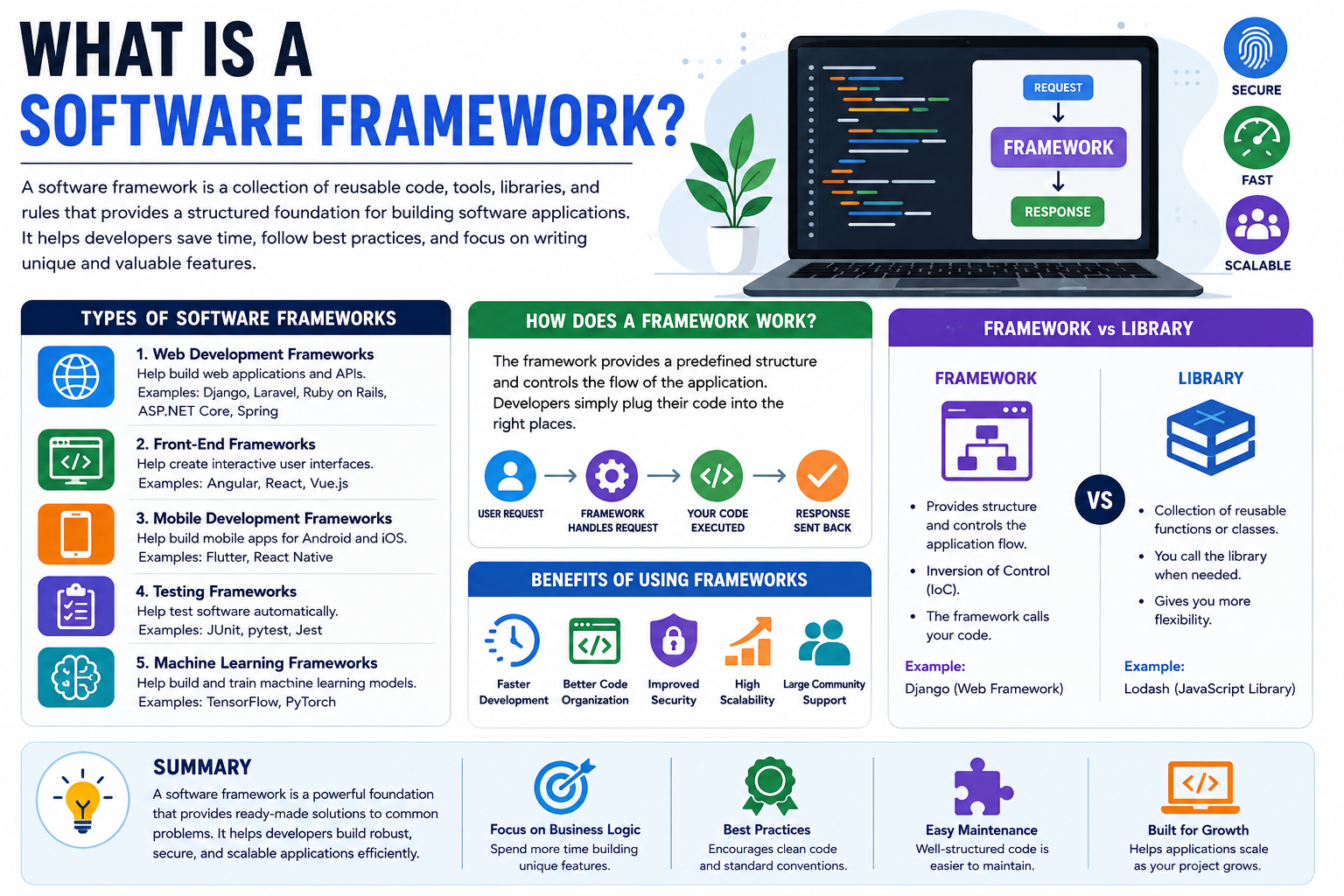
A software framework is a collection of reusable code, tools, libraries, and rules designed to help developers create software applications. It provides a predefined structure that developers can customize according to their project requirements.
For example, if you want to build a web application, you could write every component yourself, including routing, authentication, database communication, and request handling. This could take a significant amount of time.
Alternatively, you could use a framework such as Django, Laravel, or ASP.NET Core. These frameworks provide many common features, allowing developers to concentrate on the unique functionality of their applications.
A framework does not necessarily provide a complete application. Instead, it gives developers the foundation and structure needed to build one.
How Does a Software Framework Work?
Frameworks typically provide developers with reusable components and a predefined architecture. The developer adds their own code within that structure.
One important concept is Inversion of Control (IoC). In traditional programming, your code usually calls libraries when it needs them. With a framework, the framework often controls the overall flow of the application and calls your code at the appropriate time.
For example, in a web framework, a user might request a webpage. The framework can receive the request, determine which part of the application should handle it, process the response, and return the result to the user.
This structure creates consistency and reduces the amount of repetitive code developers need to write.
Types of Software Frameworks
There are many different types of frameworks, depending on the kind of software being developed.
1. Web Development Frameworks
Web frameworks help developers build websites and web applications. Popular examples include Django, Laravel, Ruby on Rails, ASP.NET Core, and Spring.
These frameworks can provide features such as routing, authentication, database integration, form handling, and security tools.
2. Front-End Frameworks
Front-end frameworks and libraries help developers create interactive user interfaces. Examples include Angular, Vue.js, and frameworks built around technologies such as React.
They help developers organize interface components and create applications that respond dynamically to user actions.
3. Mobile Development Frameworks
Mobile frameworks allow developers to build applications for smartphones and tablets. Flutter and React Native are popular examples.
One major advantage of some mobile frameworks is the ability to develop applications for multiple platforms using a shared codebase.
4. Testing Frameworks
Testing frameworks help developers automatically test their software. Examples include JUnit, pytest, and Jest.
Automated testing can identify bugs early and help ensure that changes to an application do not accidentally break existing functionality.
5. Machine Learning Frameworks
Machine learning frameworks provide tools for developing and training artificial intelligence models. TensorFlow and PyTorch are well-known examples.
They provide functionality for handling data, creating models, performing calculations, training systems, and evaluating results.
Benefits of Using a Software Framework
One of the biggest benefits of a framework is faster development. Developers can use existing components instead of creating common functionality from scratch.
Frameworks can also improve code organization. Because they usually follow established structures and conventions, developers can create projects that are easier to understand and maintain.
Another advantage is security. Established frameworks often provide built-in security mechanisms and recommended practices. While developers still need to configure and use them correctly, these features can reduce the risk of common mistakes.
Frameworks can also improve scalability. A well-designed framework can help developers organize large applications so that new features can be added without completely restructuring the project.
Finally, popular frameworks often have large developer communities. This means developers can find documentation, tutorials, examples, plugins, and solutions to common problems.
Framework vs. Library: What Is the Difference?
The terms framework and library are sometimes used interchangeably, but they are not exactly the same.
A library is generally a collection of reusable code that your application calls when it needs a particular function.
A framework usually provides a larger structure and controls more of the application’s overall flow.
A simple way to remember the difference is:
With a library, you call the code. With a framework, the framework often calls your code.
For example, a developer might use a library to perform a specific calculation, while a web framework can manage the overall structure and lifecycle of a web application.
Are Software Frameworks Necessary?
Frameworks are not mandatory. Developers can create applications without them, and sometimes building software from scratch is appropriate.
However, frameworks are extremely useful for many modern software projects. They can reduce development time, encourage consistent practices, and provide solutions to common technical challenges.
The choice of framework should depend on the project’s requirements, programming language, team expertise, performance needs, security requirements, and long-term maintenance plans.
Using a framework simply because it is popular does not automatically make a project better. Developers should choose a framework that fits their specific needs.
Conclusion
A software framework is a structured foundation that helps developers build applications more efficiently. It provides reusable code, tools, conventions, and architectural patterns that reduce the need to solve common problems from scratch.
From web and mobile development to testing and machine learning, frameworks are used across almost every area of modern software development.
For beginners, learning a framework can initially seem challenging because there are many concepts to understand. However, once the underlying structure becomes familiar, frameworks can make development significantly more organized and productive.
In short, a software framework provides the foundation, while developers build the application on top of it. Choosing and using the right framework can save time, improve code quality, and make complex software projects easier to develop and maintain.