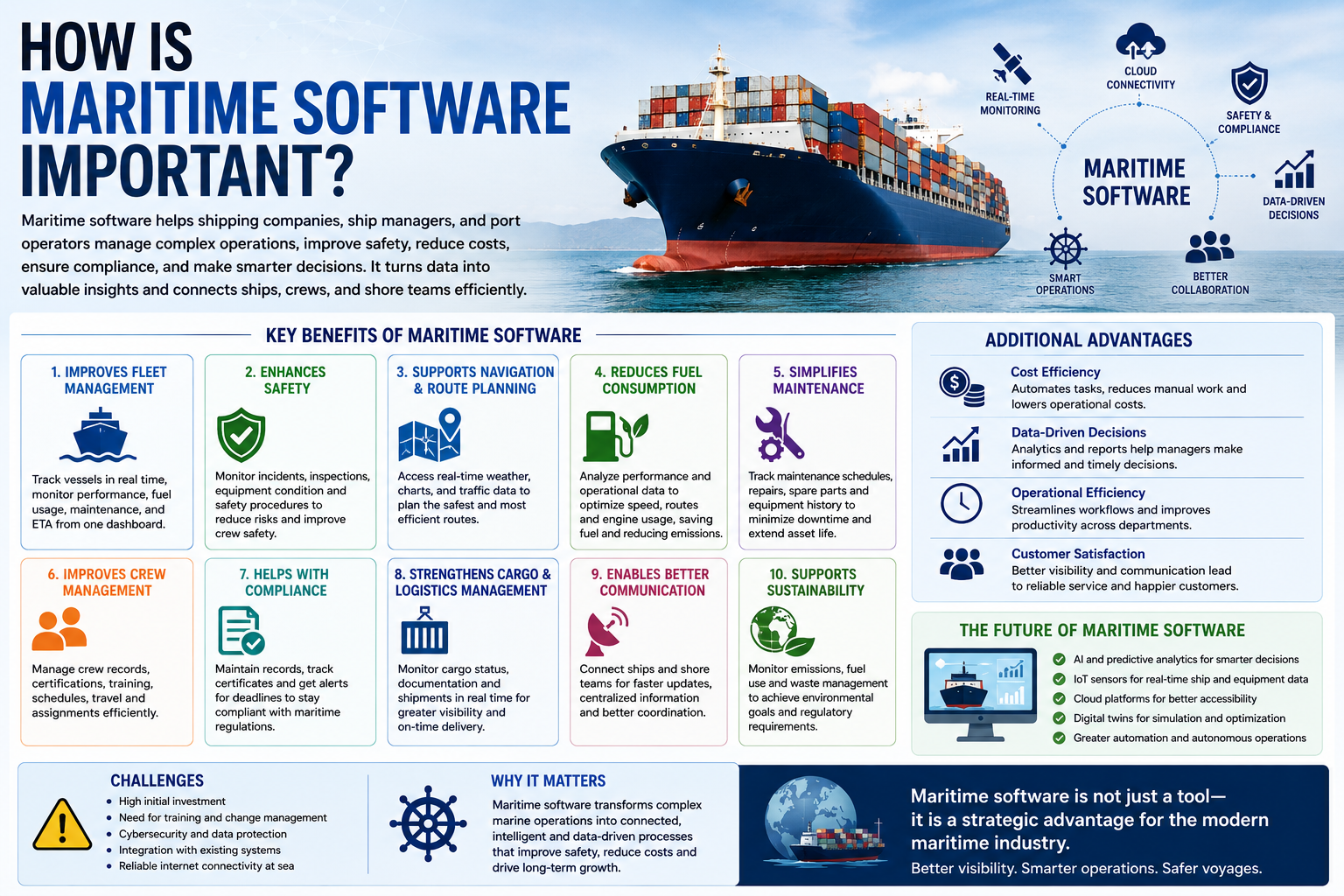
The maritime industry plays a critical role in global trade, transporting goods, fuel, raw materials, and other products across oceans and waterways. However, operating ships and managing maritime businesses involves complex activities, including navigation, fleet management, cargo handling, maintenance, compliance, crew management, and communication. Maritime software helps organizations manage these activities more efficiently by replacing manual processes with digital tools and real-time information.
From shipping companies and port operators to ship managers and logistics providers, maritime businesses increasingly depend on software to improve safety, reduce costs, and make better operational decisions.
What Is Maritime Software?
Maritime software refers to digital applications and platforms designed specifically for the shipping and marine industries. Depending on the system, it can help manage ships, crews, cargo, routes, maintenance, documentation, compliance, finances, and communications.
Some maritime software is designed for use onboard vessels, while other systems are used by shipping companies from offices or operations centers. Cloud-based platforms can also connect ships with shore-based teams, allowing information to be shared more quickly.
The main objective is to improve efficiency, safety, visibility, and decision-making throughout maritime operations.
1. Improves Fleet Management
Managing a fleet of ships requires constant monitoring. A company may need to know where vessels are located, their operational status, fuel consumption, maintenance schedules, and estimated arrival times.
Maritime fleet-management software brings this information into a centralized system. Managers can monitor vessels, review performance data, and coordinate operations more effectively.
Instead of relying entirely on spreadsheets, emails, and phone calls, teams can use digital dashboards to access important information in one place.
2. Enhances Maritime Safety
Safety is one of the most important priorities in the maritime industry. Ships operate in environments where weather, equipment failures, navigation risks, and human error can create serious challenges.
Software can support safety management by helping crews and shore-based teams monitor incidents, inspections, equipment conditions, and safety procedures.
Digital systems can also help organizations maintain records and ensure that important safety tasks are completed on schedule.
Technology does not replace trained crews or professional judgment, but it can provide useful information that supports safer decision-making.
3. Supports Navigation and Route Planning
Navigation software is another important area of maritime technology. Modern systems can assist crews with route planning, vessel positioning, weather information, charts, and other navigational data.
Better route planning can help vessels avoid unnecessary delays and potentially reduce fuel consumption. Software can also help operators evaluate changing weather and traffic conditions when planning voyages.
For shipping companies, efficient routes can translate into lower operating costs and improved delivery schedules.
4. Reduces Fuel Consumption
Fuel is one of the largest operating expenses for many commercial vessels. Even relatively small improvements in fuel efficiency can produce significant savings over time.
Maritime software can analyze information such as vessel speed, engine performance, route characteristics, weather conditions, and fuel consumption.
With this information, operators can identify inefficient practices and make data-driven decisions. Some advanced platforms can also provide analytics and recommendations designed to improve vessel performance.
Reducing fuel consumption has an additional benefit: it can help lower emissions and support environmental objectives.
5. Simplifies Maintenance
Regular maintenance is essential for keeping ships operational and preventing equipment failures. Traditional maintenance management can involve large quantities of paperwork and manually maintained schedules.
Computerized maintenance-management systems can track equipment, inspections, repairs, spare parts, and maintenance deadlines.
When a maintenance task becomes due, the system can notify the responsible team. Historical maintenance records can also help engineers understand recurring problems and make better decisions about repairs or equipment replacement.
6. Improves Crew Management
A vessel depends heavily on its crew, making crew management another important part of maritime operations.
Crew-management software can help companies organize employee records, contracts, certifications, schedules, training, travel arrangements, and assignments.
Digital records make it easier for authorized personnel to determine whether crew members have the appropriate qualifications and documents for their roles.
Efficient crew management can reduce administrative work and help organizations plan staffing requirements more effectively.
7. Helps With Regulatory Compliance
Maritime companies must follow numerous regulations and industry requirements. Keeping track of documentation, inspections, certifications, environmental requirements, and reporting obligations can be challenging.
Maritime software can centralize compliance-related information and provide reminders for important deadlines.
This helps organizations maintain more accurate records and reduces the risk of missing important requirements. However, software should be viewed as a support tool rather than a replacement for professional compliance management.
8. Strengthens Cargo and Logistics Management
Cargo management is at the heart of commercial shipping. Companies need to know what is being transported, where it is located, when it is expected to arrive, and whether the necessary documentation is complete.
Maritime logistics software can provide greater visibility into cargo movements and connect shipping information with wider supply-chain operations.
Better visibility can help companies communicate more accurately with customers, ports, freight forwarders, and other stakeholders.
9. Enables Better Communication
Ships may operate thousands of kilometers away from company headquarters. Reliable communication between vessels and shore-based teams is therefore essential.
Modern maritime platforms can bring operational information into shared digital environments, allowing authorized personnel to communicate and exchange updates more efficiently.
Centralized communication can reduce misunderstandings and ensure that different departments are working with the same information.
10. Supports Environmental Sustainability
The maritime industry is under increasing pressure to reduce emissions and improve environmental performance.
Software can help organizations monitor fuel consumption, emissions, vessel performance, waste management, and other environmental indicators.
By analyzing operational data, companies can identify areas where resources are being wasted and develop strategies to improve efficiency.
Challenges of Maritime Software
Despite its advantages, implementing maritime software can present challenges. Companies may need to invest in hardware, training, cybersecurity, software integration, and reliable connectivity.
Another important consideration is data security. Maritime systems can contain sensitive operational and commercial information, making cybersecurity essential. Organizations should use reputable software providers, establish access controls, keep systems updated, and train employees to recognize cyber threats.
The Future of Maritime Software
The future of maritime software is likely to involve greater use of artificial intelligence, automation, cloud computing, Internet of Things (IoT) sensors, predictive analytics, and digital twins.
Connected sensors can provide continuous information about engines and equipment, while AI-powered analytics can help identify unusual patterns and potential maintenance problems.
As these technologies develop, maritime software will increasingly become a central part of intelligent vessel and fleet management.
Final Thoughts
Maritime software is important because it helps the shipping industry manage increasingly complex operations in a more organized and data-driven way. From fleet management and navigation to maintenance, crew management, safety, compliance, cargo tracking, and fuel efficiency, digital systems can improve many areas of maritime business.
The greatest benefit is not simply automation. The real value comes from giving maritime professionals better information at the right time so they can make informed decisions.
As global shipping continues to become more connected and technologically advanced, maritime software will remain an important tool for creating safer, more efficient, cost-effective, and sustainable maritime operations.