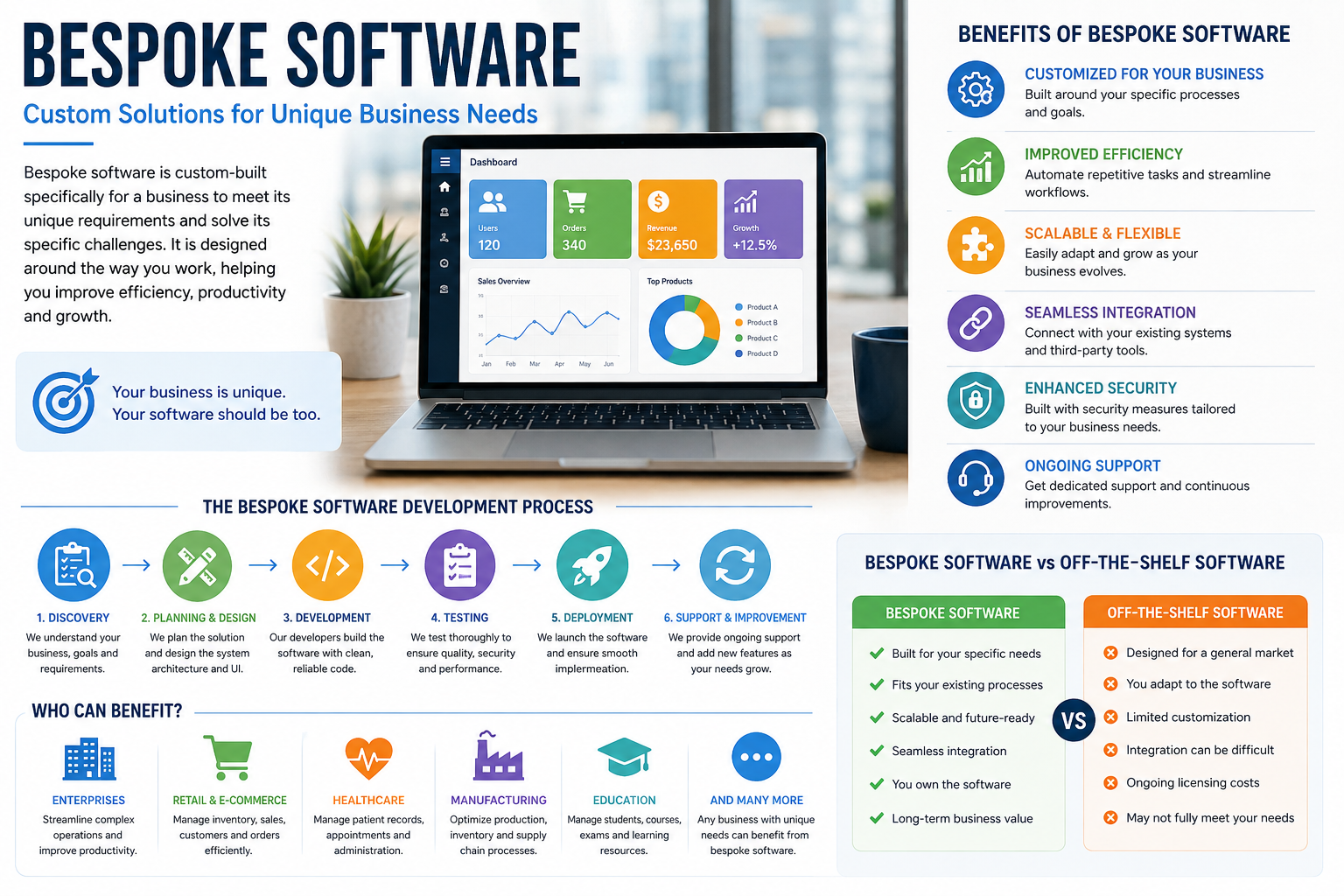
In today’s digital business environment, software plays an important role in improving productivity, managing information, communicating with customers, and automating everyday tasks. While many businesses use ready-made software, some organizations need solutions designed specifically around their unique requirements. This is where bespoke software becomes valuable. Bespoke software, also known as custom software, is developed specifically for a particular business, organization, or user rather than being created for the general market.
What Is Bespoke Software?
Bespoke software is a technology solution created to meet the specific needs of an individual organization. Unlike off-the-shelf software, which provides standardized features for a large number of users, bespoke software is designed around a company’s particular processes, goals, and challenges.
For example, a retail company may require software that combines inventory management, customer information, sales tracking, and supplier management in one system. Instead of adapting several existing applications, the company could commission bespoke software that provides exactly these functions.
The development process usually begins with understanding the organization’s requirements. Software developers work with business owners, managers, and employees to identify problems and determine which features the new system should include.
How Does Bespoke Software Work?
The development of bespoke software normally involves several stages. First, developers analyze the business requirements and understand existing workflows. This stage is important because the software needs to solve real business problems rather than simply provide unnecessary features.
Next, developers design the system architecture and user interface. After the design is approved, programmers begin developing the software. The system is then tested to identify errors, security weaknesses, and usability problems.
Once testing is completed, the software is deployed. However, development does not necessarily end at launch. Businesses often require updates, maintenance, security improvements, and additional features as their needs change.
Benefits of Bespoke Software
One of the biggest advantages of bespoke software is customization. Because the system is developed for a specific organization, it can be designed around existing business processes. Employees do not have to completely change the way they work simply to fit the limitations of a standard application.
Another major benefit is scalability. A bespoke system can be developed with future growth in mind. As a business expands, developers can add new functions, users, integrations, or databases without necessarily replacing the entire system.
Bespoke software can also improve efficiency and productivity. Repetitive tasks can be automated, information can be organized more effectively, and employees can access the tools they need from a single platform. This can reduce manual work and help employees concentrate on more important responsibilities.
Integration is another important advantage. A custom system can be designed to communicate with existing business applications, databases, payment systems, websites, or other digital services. This can reduce the need to transfer information manually between different platforms.
Security and Bespoke Software
Security is an important consideration for every modern organization. Bespoke software can be developed with security requirements specific to the business. Developers can implement user authentication, access controls, encryption, activity monitoring, backups, and other security measures according to the organization’s needs.
However, custom software is not automatically secure simply because it is bespoke. Security depends on the quality of development, testing, maintenance, and ongoing monitoring. Businesses should therefore work with experienced developers and regularly update their systems.
Challenges of Bespoke Software
Although bespoke software offers many benefits, it also has some challenges. The initial development cost can be higher than purchasing ready-made software. Development can also take considerable time because the system must be designed and built from the ground up.
Another consideration is maintenance. Businesses may need a development team or software provider to provide technical support, fix problems, install updates, and introduce new features.
For these reasons, organizations should carefully evaluate their requirements before beginning a custom software project. A clear plan, realistic budget, and well-defined objectives can reduce development risks.
Bespoke Software vs. Off-the-Shelf Software
The main difference between bespoke and off-the-shelf software is customization. Off-the-shelf applications are designed for a broad audience and can usually be purchased and implemented quickly. They may be more affordable initially, but businesses sometimes have to adjust their processes to match the software.
Bespoke software takes the opposite approach. The software is adapted to the business, allowing the organization to create workflows and features that match its specific requirements. This can make custom software particularly useful for companies with complex operations or specialized needs.
Who Can Benefit From Bespoke Software?
Bespoke software can benefit businesses of many sizes and industries. Financial organizations may use custom systems for managing specialized financial processes. Healthcare organizations can develop systems for managing appointments, records, and administrative operations. Manufacturing companies can use custom software for production planning, inventory management, and supply-chain activities.
Small and medium-sized businesses can also benefit when standard software does not provide the flexibility they need. The important factor is not simply the size of the company but whether custom software can provide enough value to justify its development and maintenance costs.
Conclusion
Bespoke software provides businesses with a flexible way to address unique technological requirements. Instead of forcing an organization to adapt to a standard application, custom software is designed around the organization’s processes, objectives, and users. Its major benefits include customization, scalability, automation, integration, and the ability to support specialized business operations.
Although bespoke software may require greater investment and planning than off-the-shelf solutions, it can provide significant long-term value when developed correctly. For businesses with unique challenges or complex workflows, bespoke software can become an important digital asset that supports efficiency, growth, and innovation.