Managing employee salaries is one of the most important responsibilities of any business. Payroll involves much more than simply paying employees each month. Companies must calculate wages, overtime, bonuses, deductions, taxes, benefits, leave, and other payments while maintaining accurate records. Even a small mistake can lead to employee dissatisfaction, financial problems, or compliance issues.
This is where payroll software becomes valuable. Payroll software automates many payroll-related tasks and helps businesses process employee payments more accurately and efficiently. Whether a company has a few employees or a large workforce, the right payroll system can save time, reduce administrative work, and improve payroll management.
What Is Payroll Software?
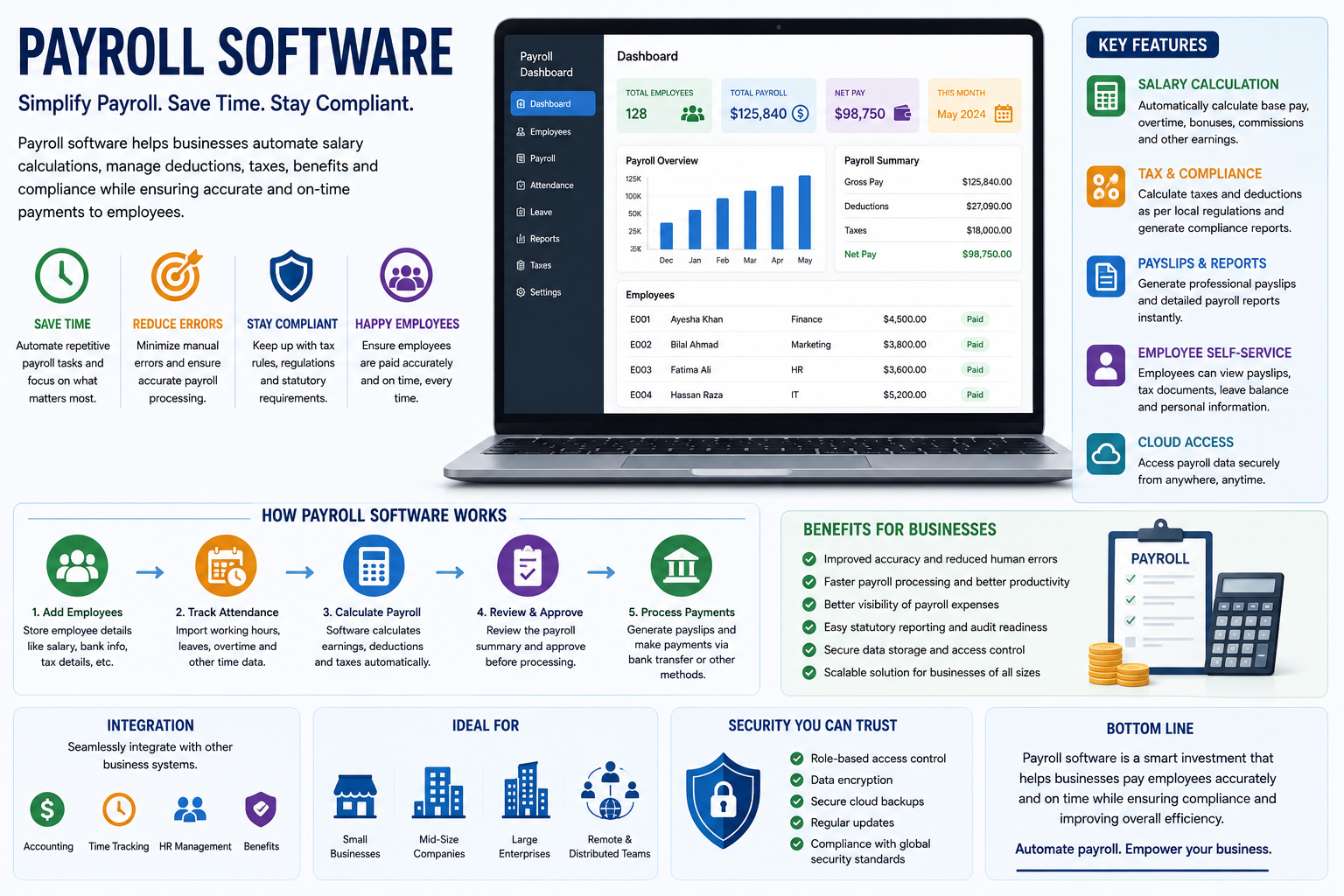
Payroll software is a digital system designed to help businesses manage employee compensation and payroll-related activities. Depending on the platform, it can calculate salaries, deductions, taxes, overtime, bonuses, benefits, and other payments.
Modern payroll systems may also include employee self-service portals, attendance tracking, leave management, reporting, tax documentation, and integration with accounting software.
Instead of maintaining complicated spreadsheets and performing calculations manually, payroll administrators can use a centralized system to manage employee information and payroll processes.
How Does Payroll Software Work?
Payroll software generally begins by storing employee information such as salary, working hours, tax details, benefits, and payment preferences.
When a payroll period begins, the software uses this information to calculate employee earnings. It can take into account factors such as regular working hours, overtime, paid leave, bonuses, commissions, and deductions.
After calculations are completed, payroll administrators can review the results before payments are processed. Depending on the system and country, the software may also assist with tax calculations, payroll reports, payslips, and required filings.
The exact features vary between providers, so businesses should select software based on their local payroll requirements.
1. Saves Time
One of the biggest advantages of payroll software is automation. Payroll administrators no longer need to calculate every employee’s salary manually.
Recurring calculations can be automated, allowing payroll teams to spend more time on important activities such as reviewing payroll data, handling employee questions, and improving financial processes.
For businesses with many employees, these time savings can be substantial.
2. Reduces Payroll Errors
Manual payroll calculations can result in mistakes. An incorrect working-hour figure, deduction, tax calculation, or employee record can affect the final payment.
Payroll software uses predefined rules and automated calculations to reduce the likelihood of common errors.
However, automation does not guarantee perfect results. Businesses should regularly review employee information, payroll settings, and calculations to ensure that the system is configured correctly.
3. Improves Employee Payment Management
Employees expect their salaries to be calculated accurately and paid on time. Payroll software can help businesses maintain consistent payroll schedules.
Many platforms also provide digital payslips that employees can access through an online portal. Instead of contacting HR for every document, employees may be able to view their salary information, payment history, tax documents, or benefits directly.
This can improve transparency and reduce administrative requests.
4. Helps With Tax and Compliance
Payroll regulations can be complicated because requirements vary by country and sometimes by region. Businesses may need to calculate taxes, social contributions, deductions, and other statutory payments.
Payroll software can help automate calculations and generate reports required for payroll administration.
Businesses should remember that software is not a substitute for professional tax or legal advice. Payroll rules change over time, and companies should make sure their software is updated and configured according to current local requirements.
5. Provides Better Payroll Records
Accurate records are essential for financial management. Payroll systems can store information about employee salaries, deductions, payments, leave, benefits, and payroll history.
These records can make it easier to answer employee questions, prepare reports, review payroll expenses, and support audits.
Digital records can also reduce dependence on paper documents and spreadsheets.
6. Supports Employee Self-Service
Many modern payroll platforms offer employee self-service features. Employees can log into a secure portal to access information such as payslips, tax documents, leave balances, and personal details.
Some systems allow employees to update certain information themselves, subject to company approval.
This reduces the workload for HR and payroll teams while giving employees faster access to their information.
7. Integrates With Other Business Software
Payroll does not operate separately from the rest of a business. Companies often need to connect payroll with accounting, human resources, attendance, time tracking, and benefits systems.
Payroll software with integrations can automatically transfer relevant information between platforms.
For example, working hours recorded through an attendance system may be used to calculate employee pay. Payroll information can then be transferred to accounting software for financial reporting.
Choosing the Right Payroll Software
There are many payroll platforms available, so businesses should carefully evaluate their needs before choosing one.
Consider the following factors:
Business size: A small company may only need basic payroll features, while a larger organization may require advanced workforce management.
Local compliance: Make sure the software supports the tax and employment requirements applicable to your location.
Ease of use: A complicated payroll system can create additional work. Look for an interface that employees and administrators can understand easily.
Security: Payroll contains sensitive employee and financial information. Strong access controls, encryption, authentication, and secure data management should be priorities.
Integration: Check whether the platform connects with your accounting, HR, attendance, and other business systems.
Scalability: Choose software that can grow with your company rather than forcing you to replace the system when your workforce expands.
Customer support: Reliable support can be particularly important when payroll deadlines are approaching.
Cloud Payroll vs Desktop Payroll
Traditional payroll software may be installed directly on a company’s computers, while cloud payroll systems are accessed through the internet.
Cloud-based systems can offer advantages such as remote access, automatic updates, centralized data, and easier collaboration. Desktop solutions may still appeal to organizations that prefer local data management or have specific infrastructure requirements.
The best choice depends on the company’s security policies, technical environment, budget, and operational needs.
The Future of Payroll Software
Payroll technology continues to evolve. Artificial intelligence, automation, mobile applications, analytics, and employee self-service are increasingly becoming important parts of modern payroll platforms.
AI-assisted systems may help identify unusual payroll patterns or automate repetitive administrative tasks. Advanced analytics can also help businesses understand labor costs and workforce trends.
As businesses become more distributed and employees work from different locations, cloud-based payroll platforms are likely to remain increasingly important.
Final Thoughts
Payroll software can transform a complicated administrative process into a more organized and automated workflow. It can help businesses calculate salaries, manage deductions, maintain records, generate reports, support compliance, and provide employees with convenient access to payroll information.
The right payroll system can save time, reduce errors, improve employee experience, and give businesses better visibility into workforce costs.
However, choosing software should not be based solely on price. Businesses should consider payroll requirements, security, integrations, scalability, ease of use, customer support, and local regulations.
With the right solution, payroll becomes more than a routine administrative task—it becomes a reliable digital process that supports employees, HR teams, accountants, and the wider business.