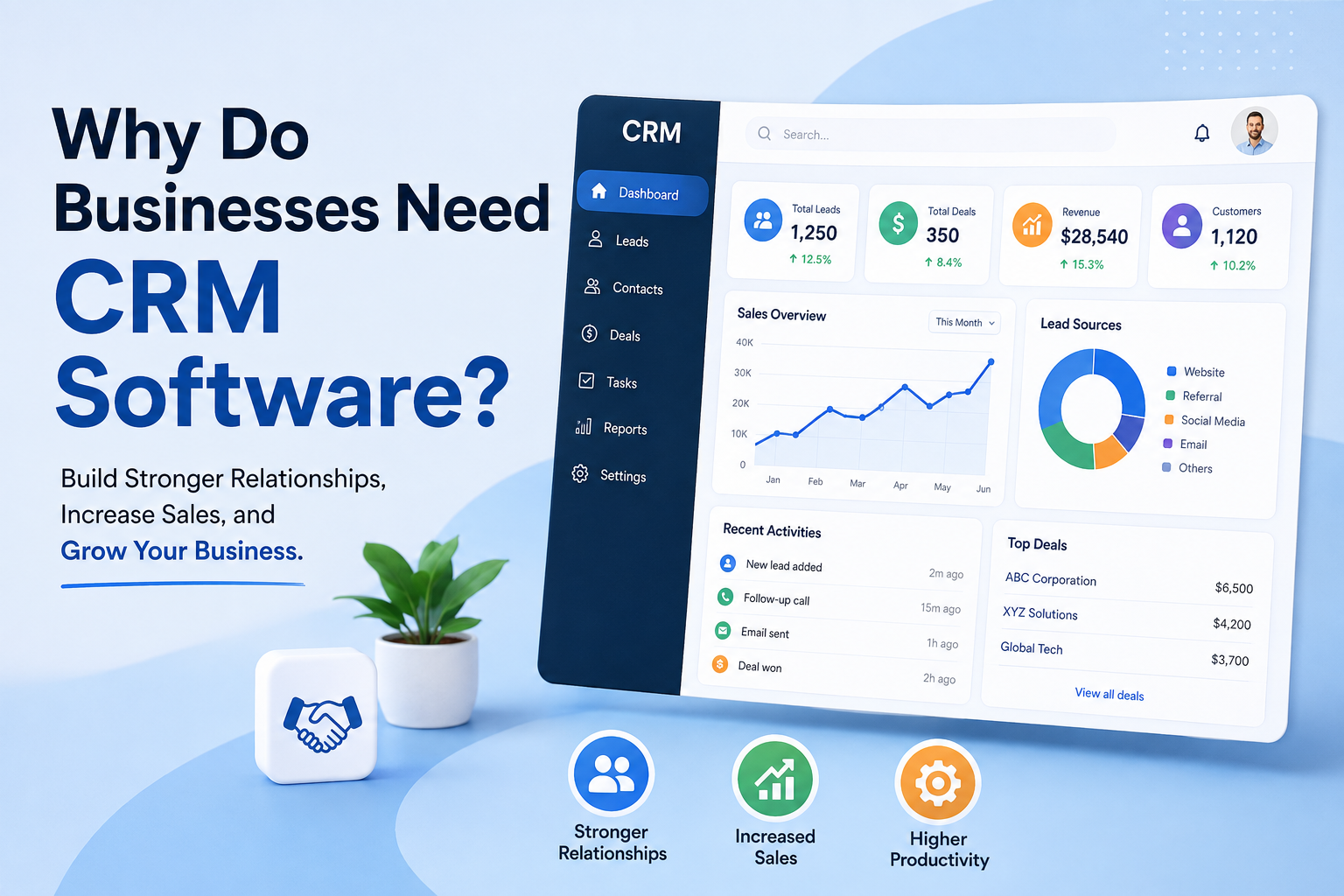
Managing customer relationships effectively is just as important as attracting new customers. As businesses grow, customer information, sales activities, follow-ups, and communications can quickly become difficult to manage using spreadsheets, emails, or scattered tools.
This is where CRM (Customer Relationship Management) software can make a significant difference.
What Is CRM Software?
CRM software is a technology solution that helps businesses organize and manage their interactions with current and potential customers. It brings important customer information, sales activities, communication history, and business processes into one centralized platform.
Instead of relying on multiple spreadsheets and applications, teams can use a CRM to access the information they need and manage customer relationships more efficiently.
Why Do Businesses Need CRM Software?
1. Centralize Customer Information
One of the biggest advantages of CRM software is that it keeps customer information in one place.
Businesses can store details such as:
- Customer contact information
- Communication history
- Leads and opportunities
- Previous purchases
- Sales activities
- Notes and follow-up reminders
This makes it easier for employees to find accurate customer information without searching through emails, spreadsheets, or different systems.
2. Improve Customer Relationships
Strong customer relationships can lead to repeat business and long-term customer loyalty.
CRM software helps businesses understand customer interactions and preferences. Sales and support teams can see previous conversations and activities, allowing them to provide more relevant and personalized communication.
When customers receive timely and consistent support, their overall experience can improve.
3. Increase Sales Productivity
Sales teams often spend considerable time performing repetitive administrative tasks.
CRM software can automate activities such as:
- Follow-up reminders
- Lead assignments
- Data entry
- Sales notifications
- Email workflows
- Task management
By reducing manual work, sales representatives can spend more time communicating with prospects and closing deals.
4. Manage Leads and Sales Pipelines
Without a structured system, it can be difficult to know which leads are new, which prospects need follow-up, and which deals are close to completion.
A CRM provides visibility into the sales pipeline. Businesses can track prospects from the initial interaction through different stages of the sales process.
This helps sales managers identify opportunities, monitor team performance, and prevent valuable leads from being forgotten.
5. Make Better Data-Driven Decisions
Business decisions are stronger when they’re based on reliable data.
CRM systems can provide reports and analytics related to sales, customers, leads, revenue, and team performance. Managers can use these insights to identify trends and determine what is working and where improvements are needed.
For example, a company can analyze which lead sources generate the most qualified prospects and focus more resources on those channels.
6. Improve Customer Support
Customer support teams need quick access to customer information when resolving questions or problems.
With CRM software, support representatives can view customer history and previous interactions from a centralized system. This can reduce the need for customers to repeatedly explain their situation and help teams respond more efficiently.
7. Improve Team Collaboration
CRM software can also connect different departments around shared customer information.
Sales, marketing, and customer service teams can work from the same customer records rather than maintaining separate databases.
For example, when a salesperson updates a customer’s status, other authorized team members can access the latest information and continue the customer journey without unnecessary communication gaps.
Who Can Benefit From CRM Software?
CRM software isn’t limited to large corporations. Businesses of different sizes and industries can benefit from it, including:
- Small businesses
- Startups
- E-commerce companies
- Sales organizations
- Marketing agencies
- Real estate businesses
- B2B companies
- Customer service teams
- Professional service providers
The right CRM can be particularly valuable as a business grows and the number of customers, leads, and employees increases.
What Happens Without a CRM?
Businesses that rely heavily on spreadsheets, personal notes, and disconnected applications may face several challenges, including:
- Lost or forgotten leads
- Missed follow-ups
- Duplicate customer information
- Poor communication between departments
- Difficulty tracking sales performance
- Time-consuming manual processes
- Limited visibility into customer relationships
These problems may become increasingly difficult to manage as the business expands.
How to Choose the Right CRM Software
Before choosing a CRM, businesses should consider their specific requirements. Important factors include:
Ease of use: Employees should be able to learn and use the platform without unnecessary complexity.
Automation: Look for features that can automate repetitive sales, marketing, and customer service tasks.
Integrations: The CRM should work with the tools your business already uses, such as email, accounting, marketing, or e-commerce platforms.
Reporting: Make sure the system provides useful reports and analytics.
Scalability: Choose software that can grow with your business.
Security: Customer information should be protected through appropriate security and access controls.
Conclusion
CRM software is more than a database for storing customer information. It can become a central system for managing customer relationships, improving sales processes, automating repetitive tasks, and helping teams make better decisions.
For growing businesses, having the right CRM can mean fewer missed opportunities, better collaboration, more efficient workflows, and stronger customer relationships.
If your business is still managing customers and leads through spreadsheets and disconnected tools, it may be time to consider what a CRM can do for your growth.