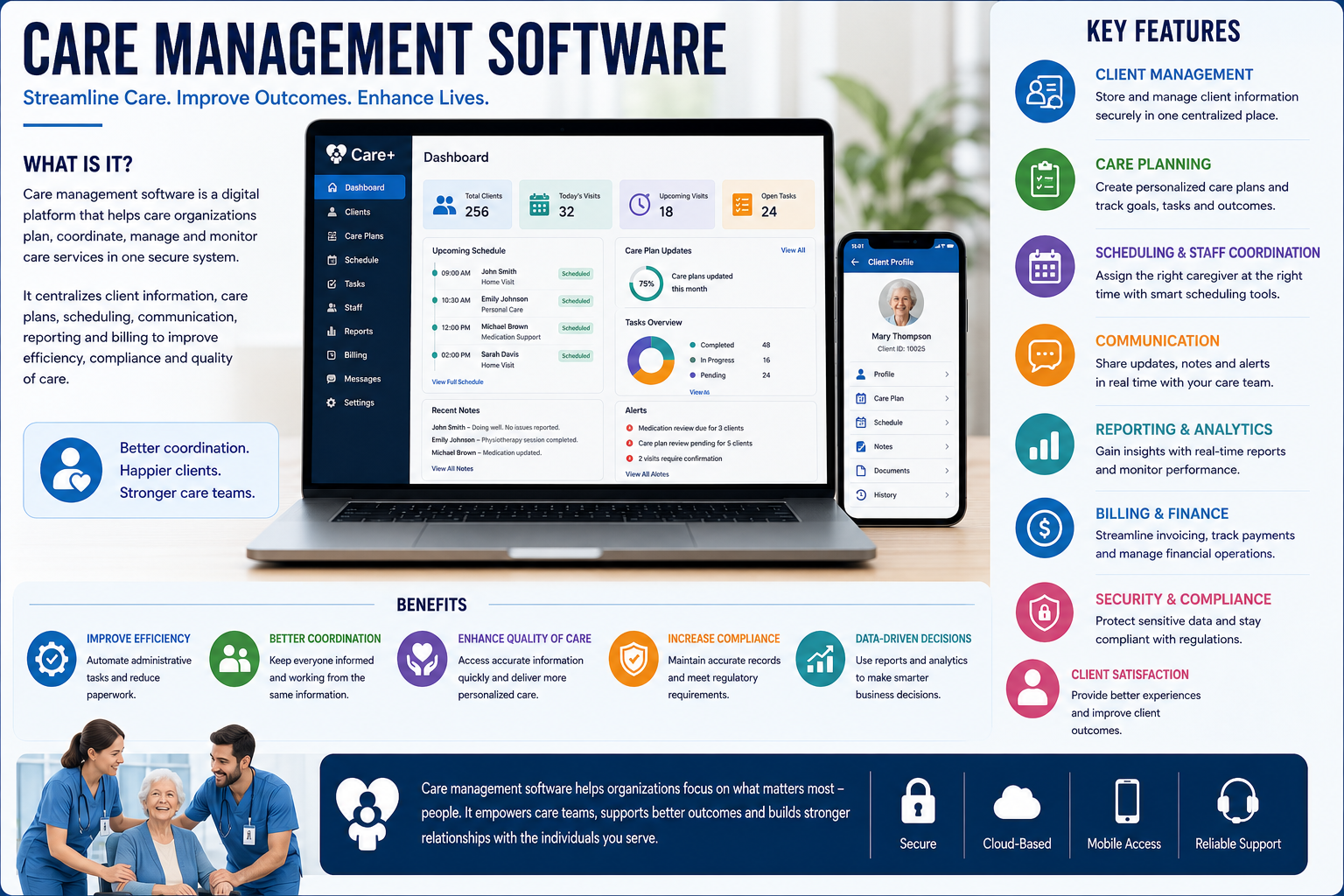
Care organizations handle a wide range of responsibilities every day, from managing client information and coordinating services to communicating with caregivers and monitoring care plans. Managing all of these activities manually can be difficult, time-consuming, and prone to errors. Care management software provides a digital solution that helps care providers organize these processes and deliver more efficient, coordinated services.
Care management software is designed for organizations and professionals involved in providing care. Depending on the system, it can be used by home care agencies, residential care providers, community care organizations, healthcare teams, and other service providers. Its main purpose is to bring important care-related information and workflows together in one secure platform.
What Is Care Management Software?
Care management software is a digital platform that helps care providers plan, coordinate, document, and monitor services for individuals receiving care. It can replace spreadsheets, paper records, and disconnected systems with centralized digital tools.
A typical system may include features for client records, care plans, scheduling, staff management, communication, reporting, billing, and compliance. By connecting these functions, organizations can reduce administrative work and improve visibility across their operations.
The exact features vary depending on the provider and the type of care organization using the software. However, most solutions are designed to make care delivery more organized and information easier to access.
Managing Client Information
One of the most important functions of care management software is maintaining client records. Care providers need accurate information about the people they support, including personal details, care requirements, appointments, notes, and service history.
Instead of keeping information in separate paper files, organizations can store relevant records in a centralized digital system. Authorized staff can access the information they need, helping them understand a client’s requirements and provide more consistent services.
Good information management can also reduce the risk of lost documents and duplicate records.
Creating and Managing Care Plans
Care plans provide guidance about the services and support an individual needs. Care management software can help organizations create, update, and monitor these plans digitally.
Staff can record goals, tasks, preferences, schedules, and other relevant information. When a person’s needs change, authorized users can update the care plan and ensure that relevant team members have access to the latest information.
This can support more personalized and coordinated care.
Scheduling and Staff Coordination
Scheduling is another major challenge for many care organizations. Staff may need to manage appointments, shifts, visits, availability, and changes to schedules.
Care management software can simplify this process by providing digital calendars and scheduling tools. Managers can assign staff to particular visits or tasks and monitor schedules from a central dashboard.
Some systems can also provide notifications and reminders, helping reduce missed appointments and scheduling conflicts.
Communication and Collaboration
Effective communication is essential in care services. Care workers, managers, clients, families, and other professionals may all need to exchange important information.
Care management platforms can provide communication features that allow authorized users to share updates, notes, alerts, and other information. Having communication connected to client records can make it easier for teams to understand what has happened and what action may be required.
Better communication can also reduce reliance on scattered messages and paperwork.
Reporting and Documentation
Care organizations often need to produce reports for internal management, clients, regulators, or other stakeholders. Creating these reports manually can consume significant time.
Care management software can automate or simplify reporting by collecting information from different parts of the system. Managers can use reports to monitor staff activity, service delivery, appointments, incidents, and other operational information.
Digital documentation can also create clearer records of activities and decisions, supporting accountability and organizational oversight.
Billing and Financial Management
Some care management systems include billing and financial features. These may help organizations track services provided, calculate charges, manage invoices, and monitor payments.
Integrating financial information with service records can reduce repetitive data entry and help organizations maintain more accurate financial information.
For organizations with complex billing processes, these features can save considerable administrative time.
Benefits of Care Management Software
There are several potential benefits of using care management software. One of the most important is greater efficiency. Automating administrative processes allows staff to spend less time handling paperwork and more time focusing on service delivery.
Another benefit is better organization. Centralized information makes it easier for authorized employees to find records and understand current care requirements.
The software can also support better coordination by connecting scheduling, communication, care plans, and documentation. This can help different members of a care team work from the same information.
Additionally, digital systems can provide useful data and reporting capabilities, allowing managers to identify trends, monitor performance, and make informed operational decisions.
Security and Privacy
Care organizations handle sensitive personal information, making security a critical consideration. Care management software should include appropriate security measures such as user authentication, access permissions, encryption, backups, and activity monitoring.
Organizations should also ensure that their software and processes comply with the privacy and data-protection requirements applicable to their location and type of service.
Not every employee needs access to every piece of information. Role-based permissions can help organizations control who can view or modify specific records.
Choosing Care Management Software
When selecting care management software, organizations should first identify their specific requirements. Important considerations may include client record management, care planning, scheduling, communication, reporting, billing, mobile access, integrations, security, and ease of use.
The software should be simple enough for staff to learn while providing the functionality required by the organization. Reliable technical support, regular updates, scalability, and appropriate security should also be considered.
Conclusion
Care management software is an important digital tool for organizations that provide care and support services. By bringing client records, care plans, scheduling, communication, reporting, and other processes into one platform, it can reduce administrative workloads and improve coordination.
The most effective system is not necessarily the one with the largest number of features. Instead, organizations should choose software that fits their workflows, supports their staff, protects sensitive information, and can adapt as their services grow.
When implemented thoughtfully, care management software can help organizations become more organized, efficient, and responsive while supporting better coordination of care.