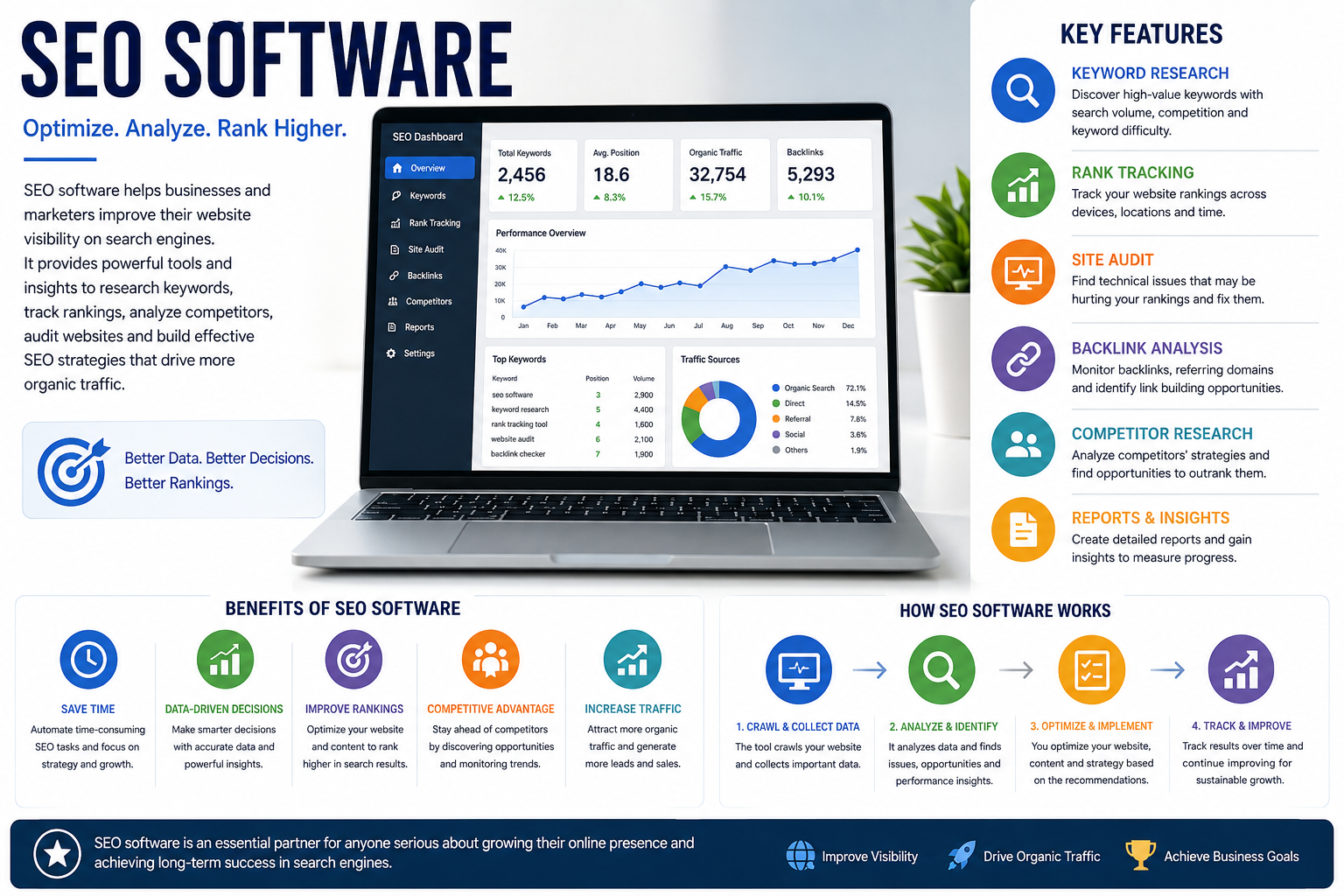
In the modern digital world, having a website is not enough to attract customers. Businesses need to make sure their websites can be easily discovered by people searching online. This is where SEO software becomes important. SEO, or Search Engine Optimization, is the process of improving a website so that it can achieve better visibility in search engine results. SEO software provides tools and data that help businesses, marketers, and website owners understand search performance and improve their online presence.
What Is SEO Software?
SEO software is a digital tool or platform designed to help users optimize websites for search engines. It can collect and analyze information about keywords, website performance, backlinks, competitors, technical problems, and search rankings.
Instead of manually checking hundreds or thousands of pages, SEO software can automate many tasks and present useful information in an organized dashboard. This makes it easier for businesses to identify opportunities, solve website problems, and develop effective SEO strategies.
SEO software can be used by small businesses, large companies, bloggers, online stores, marketing agencies, and content creators. The specific features vary between platforms, but the overall goal is to improve organic search visibility.
Keyword Research
One of the most important functions of SEO software is keyword research. Keywords are the words and phrases that people type into search engines when looking for information, products, or services.
SEO tools can help users discover relevant keywords and analyze factors such as search volume, competition, trends, and search intent. For example, a company selling running shoes might discover keywords such as “best running shoes,” “running shoes for beginners,” or “comfortable running shoes.”
By understanding what potential customers are searching for, businesses can create content that answers their questions and matches their interests.
Website Rank Tracking
SEO software can also monitor how a website performs in search engine results. Rank-tracking tools allow users to follow the positions of specific web pages for selected keywords.
Search rankings can change over time because of algorithm updates, competitor activity, content changes, and other factors. Regular monitoring helps businesses identify positive or negative trends.
For example, if an important page suddenly drops in rankings, an SEO professional can investigate possible reasons and take corrective action.
Technical SEO Audits
A website can have excellent content but still experience SEO problems because of technical issues. SEO software can scan websites and identify problems that may affect search engine crawling, indexing, or user experience.
Technical audits may detect broken links, missing metadata, duplicate content, slow-loading pages, incorrect redirects, mobile usability issues, and other problems.
Fixing these issues can help search engines understand a website more effectively and can create a better experience for visitors.
Backlink Analysis
Backlinks are links from other websites to a particular website. They can be an important part of SEO because links from reputable and relevant websites can contribute to a site’s authority.
SEO software can analyze a website’s backlink profile and show information about referring domains, link types, and potentially harmful or low-quality links. Users can also research competitors to discover websites that link to them.
This information can help businesses develop legitimate link-building and digital PR strategies.
Competitor Research
Another useful feature of SEO software is competitor analysis. Businesses rarely operate without competition online, and understanding competitors can reveal valuable opportunities.
SEO platforms can help users compare keyword rankings, content performance, backlinks, and other SEO metrics. A company may discover that a competitor is ranking for important topics that its own website has not covered.
This does not mean copying competitors. Instead, the information can help businesses identify gaps and develop better, more useful content.
Content Optimization
SEO software can also support content creation and optimization. Some tools analyze existing pages and provide recommendations related to keywords, headings, readability, internal links, and other factors.
Content optimization should not simply involve inserting keywords repeatedly. Modern SEO focuses heavily on creating useful, relevant, and trustworthy information that satisfies the searcher’s intent.
Good SEO software can therefore be used as a guide while writers focus on producing valuable content for real readers.
Benefits of SEO Software
SEO software provides several important benefits. First, it saves time by automating research, monitoring, and auditing tasks. Second, it provides data-driven insights, allowing businesses to make decisions based on measurable information rather than guesswork.
It can also improve efficiency by bringing different SEO activities into one platform. Instead of using separate systems for keyword research, rank tracking, backlink analysis, and technical audits, businesses may be able to manage many of these activities from a single dashboard.
Another benefit is competitive advantage. By monitoring competitors and identifying search opportunities, businesses can develop strategies that help them compete more effectively.
Choosing the Right SEO Software
The best SEO software depends on the organization’s goals, budget, website size, and level of expertise. Beginners may prefer simple tools with easy-to-understand dashboards, while experienced SEO professionals may require advanced analytics and reporting.
Important features to consider include keyword research, rank tracking, site auditing, backlink analysis, competitor research, reporting, integrations, and data accuracy.
Businesses should also consider whether the software offers useful support, regular updates, and flexible pricing.
Conclusion
SEO software has become an important part of modern digital marketing. From keyword research and rank tracking to technical audits, backlink analysis, competitor research, and content optimization, these tools can simplify many aspects of search engine optimization.
However, SEO software is not a replacement for strategy, creativity, or quality content. It provides information and recommendations, while businesses and marketers must use that information intelligently. When combined with valuable content, strong technical foundations, and a user-focused strategy, SEO software can help websites improve visibility, attract more relevant visitors, and support long-term online growth.