In today’s competitive business environment, companies need efficient ways to manage their operations, employees, customers, finances, and resources. As businesses grow, managing all these activities through spreadsheets and separate applications can become complicated. This is where ERP software becomes valuable.
ERP stands for Enterprise Resource Planning. ERP software is a business management system that brings different business processes together on a single platform. It allows organizations to collect, manage, and analyze information from different departments, helping employees make better decisions and work more efficiently.
What Is ERP Software?
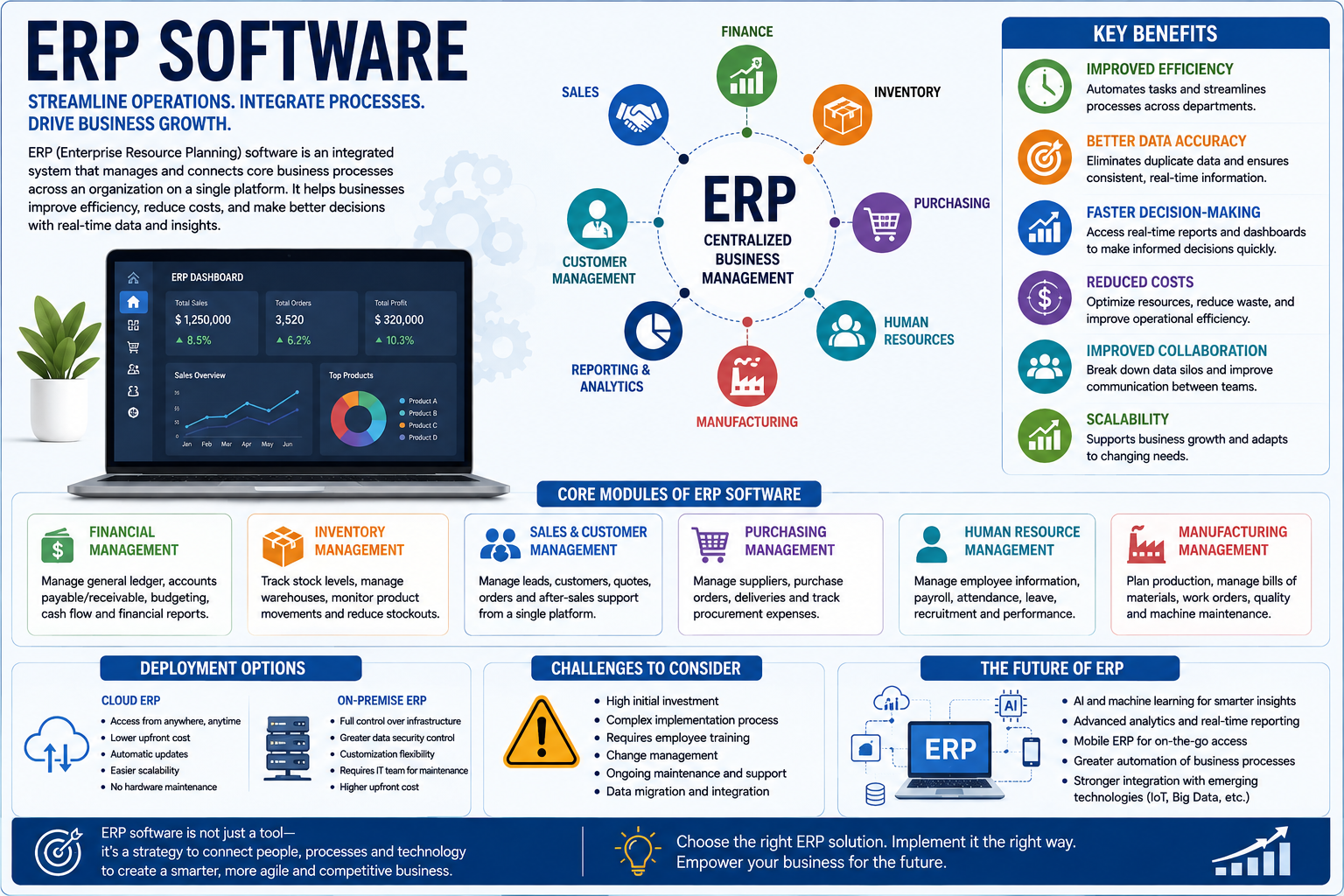
ERP software is a centralized system designed to manage and connect important business operations. Instead of using separate systems for accounting, inventory, human resources, sales, purchasing, and manufacturing, a company can use an ERP platform to manage many of these functions in one place.
For example, when a customer places an order, an ERP system can connect the sales order with inventory information, accounting records, purchasing requirements, and delivery processes. This reduces the need for employees to enter the same information into multiple systems.
The exact features of an ERP platform depend on the software provider and the needs of the organization.
Why Is ERP Software Important?
As companies grow, the amount of business information they generate increases significantly. Employees may need to manage thousands of transactions, customer records, invoices, products, suppliers, and employee details.
Without a centralized system, information can become scattered across different applications and spreadsheets. This can make it difficult for managers to understand what is happening across the organization.
ERP software creates a centralized source of business information. Authorized employees can access relevant data and use it to perform their responsibilities more efficiently.
Key Features of ERP Software
Modern ERP platforms usually contain multiple modules. Businesses can choose the modules that match their requirements.
1. Financial Management
Financial management is one of the most important ERP functions. It can help organizations manage invoices, expenses, accounts payable, accounts receivable, budgets, financial records, and reports.
By connecting financial information with other departments, companies can gain a clearer understanding of revenue, costs, and profitability.
2. Inventory Management
Inventory management is essential for retailers, wholesalers, manufacturers, and other product-based businesses.
ERP software can help track inventory levels, product movements, warehouses, purchase orders, and stock availability. Businesses can use this information to reduce overstocking and avoid running out of important products.
3. Human Resources
Many ERP systems include HR features for managing employee information, attendance, leave, payroll, recruitment, and other workforce processes.
Centralizing employee data can make administrative tasks easier and provide HR teams with better access to workforce information.
4. Sales and Customer Management
ERP software can connect sales activities with inventory, finance, and customer information. Sales teams can track orders, quotations, customers, and transactions from a centralized system.
This can help businesses provide better customer service because employees can access relevant information more quickly.
5. Procurement
Procurement modules help businesses manage purchasing activities. Companies can maintain supplier information, create purchase orders, track deliveries, and monitor purchasing expenses.
Connecting procurement with inventory management can also help businesses determine when additional products or materials are needed.
6. Manufacturing
Manufacturing businesses can use ERP software to manage production planning, materials, work orders, equipment, inventory, and quality processes.
A connected system can give manufacturers better visibility into production activities and help coordinate different stages of the manufacturing process.
Benefits of ERP Software
ERP software offers several potential benefits for organizations.
Improved Efficiency
Automation can reduce repetitive administrative work. Instead of entering information manually into multiple systems, employees can work with connected data.
Better Data Accuracy
Centralized data can reduce duplicate records and inconsistencies. When information is updated in one part of the system, other connected modules can use the updated information.
Faster Decision-Making
Managers can use reports and dashboards to understand business performance. Access to current information can help organizations make decisions more quickly.
Reduced Operating Costs
ERP systems can help businesses identify inefficient processes, reduce unnecessary administrative work, and improve resource utilization.
Improved Collaboration
When departments use a connected system, employees can share information more easily. Finance, sales, inventory, HR, and management teams can work with a common source of information.
Business Scalability
ERP software can support organizations as they expand. A growing company may add employees, products, warehouses, customers, or locations, and a scalable ERP system can help manage this increased complexity.
Cloud ERP vs Traditional ERP
ERP software can be deployed in different ways. Traditional ERP systems may be installed on a company’s own servers, while cloud ERP is hosted by a service provider and accessed through the internet.
Cloud ERP can provide advantages such as remote accessibility, automatic software updates, easier scalability, and reduced responsibility for maintaining physical servers.
However, companies should carefully evaluate internet connectivity, security, data-storage policies, integration requirements, and costs before selecting a deployment model.
Challenges of Implementing ERP Software
Although ERP software offers many advantages, implementation can be challenging.
ERP systems can be complex, and employees may need training before they can use them effectively. Businesses may also need to migrate data from older systems and modify existing workflows.
Implementation costs can include software licenses or subscriptions, consulting, customization, training, data migration, and ongoing support.
Another important consideration is cybersecurity. ERP platforms can contain sensitive financial, employee, customer, and operational information. Businesses should use strong authentication, access controls, backups, monitoring, and security policies to protect their systems.
How to Choose the Right ERP Software
Before selecting an ERP system, businesses should identify their most important requirements.
Consider the company’s size, industry, number of employees, number of locations, budget, existing software, and future growth plans.
It is also important to evaluate ease of use, customization options, integrations, reporting capabilities, mobile access, security, customer support, and scalability.
Companies should avoid choosing software simply because it has the largest number of features. The best ERP system is one that solves the organization’s actual problems without creating unnecessary complexity.
The Future of ERP Software
ERP technology continues to evolve with artificial intelligence, automation, cloud computing, advanced analytics, and mobile technology.
AI-powered ERP systems may help businesses analyze large amounts of information, identify unusual patterns, automate repetitive processes, and provide recommendations.
As organizations become increasingly digital, ERP systems are likely to become more connected with ecommerce platforms, customer relationship management systems, supply-chain tools, payment platforms, and other business technologies.
Final Thoughts
ERP software is an important technology for businesses that need to manage multiple operations efficiently. By connecting finance, inventory, sales, human resources, purchasing, manufacturing, and other processes, ERP systems can create a more organized and transparent business environment.
The biggest advantage of ERP software is not simply having many features in one application. Its real value comes from connecting business information and processes so employees can work more efficiently and managers can make better decisions.
For a growing organization, choosing the right ERP platform can be a major investment. With careful planning, employee training, strong security, and proper implementation, ERP software can help businesses improve productivity, reduce inefficiencies, and build a strong foundation for long-term growth.